
The apex body for liquor firms Confederation of Indian Alcoholic Beverage Companies has urged the government to gradually reduce customs duties on British alcoholic beverages under the proposed India-UK free trade agreement to support domestic players. India and the UK have formally launched negotiations for an FTA, under which duties would be reduced or eliminated on several goods traded between the two countries. The Confederation of Indian Alcoholic Beverage Companies (CIABC) has also suggested the government to ensure that the UK allows the selling of domestic whiskies as 'Indian Whisky', irrespective of whether they are made from malt, grain spirits or molasses-based spirits.

Britain's third female prime Minister, Liz Truss, was out of office on Thursday after the shortest tenure at 10 Downing Street in London and without a cherished India-UK free trade agreement (FTA) under her belt as a Brexit prize.

The government on Friday said the country's economy was strong enough to sustain the free trade agreements entered into by India.

The leaders also noted the "negative impacts" of the war in Ukraine with regard to global food and energy security, especially for developing and least-developed countries.
The negotiations with Bangladesh for a free trade agreement will begin before October this year, External Affairs Minister Yashwant Sinha informed the Rajya Sabha on Thursday.

Amid demands for snapping trade ties with China for its transgressions on the border, former Niti Aayog vice chairman Arvind Panagariya has opined that cutting trade with Beijing at this juncture would amount to sacrificing India's potential economic growth. Instead, Panagariya suggested that India should try to enter into free trade agreements (FTA) with countries such as the UK and the European Union to expand its trade. "Engaging China in a trade war at this juncture will mean sacrificing a considerable part of our potential growth... purely on economic grounds, it will be unwise to take any action in response to it (transgressions on the border)," the eminent economist told PTI.
India feels that a free trade agreement with China will not work as it is not a market economy.
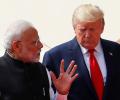
'While criticising India's high tariffs, Mr Trump stated he would impose reciprocal taxes on Indian products if re-elected.' 'However, since India's tariffs follow WTO rules, Mr Trump's actions would violate these rules,' Ajay Srivastava points out.
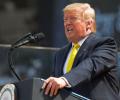
Addressing the 'Namaste Trump' event at the Motera Stadium in Ahmedabad, Trump said that both the countries are in the early stages of discussion for an 'incredible' trade agreement to reduce barriers of investments.
The 21 agreements relating to cooperation in the fields of defence, social and economic fields were signed after talks between visiting Chinese Premier Wen Jiabao and his Pakistani counterpart Shaukat Aziz.
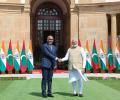
India on Monday asserted that its friendly ties with the Maldives will continue as Prime Minister Narendra Modi and President Mohamed Muizzu unveiled a blueprint for comprehensive economic and maritime cooperation, signalling a reset of the relationship that had hit a rough patch last year due to anti-New Delhi rhetoric.
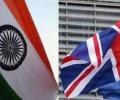
The free trade agreement (FTA) talks with India are no longer working towards a Diwali deadline though negotiations are progressing well, UK Trade Secretary Kemi Badenoch has said as New Delhi expressed confidence on Friday of an "early date" for a mutually beneficial deal. "There are ongoing negotiations as we know on the FTA. There is interest on both sides to see if we can work towards a deal, an FTA, that is beneficial to both the countries at an early date," external affairs ministry spokesperson Arindam Bagchi told reporters in New Delhi. It came as External Affairs Minister S Jaishankar spoke to his UK counterpart, James Cleverly, and referenced the Roadmap 2030 bilateral agreement signed between Prime Minister Narendra Modi and former UK PM Boris Johnson in May last year, with no specific reference to the FTA.

The decline in the trade has been attributed to factors like drop in gold imports from Australia, decline in coal prices as well as slowing down of the Indian economy.

Countries that have signed the RCEP agreement can start negotiations with India for joining the pact once New Delhi submits a written request stating its intention for the same, according to a declaration. On November 4 last year, India walked out of mega free trade agreement RCEP (Regional Comprehensive Economic Partnership) as negotiations failed to address New Delhi's outstanding issues and concerns. The remaining 15 member countries have signed RCEP agreement and have stated that the pact would remain open to India.
United States on Tuesday said it was against entering in to a limited Free Trade Agreement with India and any bilateral FTA will have to be comprehensive.

May's visit is likely to coincide with the India-United Kingdom Tech Summit in New Delhi between November 7 and 9

The government is expediting visa-related issues to bring technicians to India from any country, not just China, as and when required, to ensure the smooth implementation of the flagship production-linked incentive (PLI) scheme aimed at boosting domestic manufacturing. "If those under the PLI scheme need to get their equipment installed, we try to expedite the ability to get technicians into India from any country, whichever it may be," Union Commerce and Industry Minister Piyush Goyal told Business Standard in an interview.

'Militants are taking over the administration. Fundamentalists have been released from jail.'

The Ashes rivalry between the Australian and English cricket teams escalated to new levels, with the prime ministers of both countries jumping into the fray, again.

'If the Trump administration decides to put guardrails on H-1B visas, that will surely impact both US and Indian firms.'
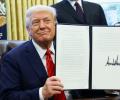
The Trump trade shock is a chance to push long-overdue reforms, rather than tinker with tariffs to appease the US, suggests M Govinda Rao.

After a quiet April-June quarter in 2024-25 (FY25), the operational and financial performance of India's largest listed hotel company, Indian Hotels Company, clearly rebounded in the July-September quarter (Q2) of FY25. With double-digit growth in the average room rate (ARR) and higher occupancy, the Taj Hotels chain owner reported a 16 per cent revenue increase and a 30 per cent rise in operating profit.

Panagariya also stressed that India must continue the liberalisation of its top tariff rates and the country should not revert back to import substitution.

Asked for China's comments on India not joining the RCEP deal over concern of cheap Chinese products potentially harming its domestic industry, Chinese foreign ministry spokesman Geng Shuang told the media in Beijing on Tuesday that China welcomes India joining the deal.

Former Niti Aayog Vice Chairman Arvind Panagariya has opined that cutting trade with Beijing at this juncture would amount to sacrificing India's potential economic growth.
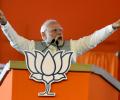
Prime Minister Narendra Modi's goal of making India a high-income economy by 2047 is unlikely to be achieved, but the country should become an upper middle-income nation by then, Financial Times chief economics commentator Martin Wolf said on Friday. Wolf further said that India would also become a superpower by 2047. "India wishes to become a high-income country by 2047.

India's gold and silver imports from its free trade agreement (FTA) partner UAE have skyrocketed 210 per cent to $10.7 billion in 2023-24 and there is a need to potentially revise the concessional customs duty rates under the pact to mitigate the arbitrage driving this surge, a report said on Monday. Economic think tank Global Trade Research Initiative (GTRI) said this sharp rise in gold and silver imports is primarily driven by import duty concessions granted by India to the UAE under the India-UAE Comprehensive Economic Partnership Agreement (CEPA).

India has flagged concerns over non-tariff barriers (NTBs) faced by its exporters with the Russian government, commerce secretary Sunil Barthwal said on Monday. NTBs faced by Indian exporters are mainly in sectors such as marine products and pharmaceuticals.
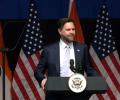
US Vice President JD Vance called on India to drop non-tariff barriers, give greater access to its markets and buy more American energy products and military hardware. Vance, in a speech in Jaipur, highlighted the need for a stronger US-India partnership for a prosperous and peaceful 21st century. He emphasized the importance of working together to address global challenges and praised Prime Minister Narendra Modi, describing him as a "special person." Vance also urged India to provide greater market access to American products and buy more defense platforms and energy from the US. He suggested that India consider dropping some of the non-tariff barriers for American access to the Indian market and highlighted the benefits of closer India-US defense collaboration, advocating for New Delhi to procure more military hardware from the US. He cited the example of American fifth-generation F-35s, arguing they would give the Indian Air Force the ability to defend its airspace and protect its people like never before. Vance also welcomed the Modi government's budget announcement to amend India's civil nuclear liability laws, paving the way for US producers to export small modular reactors and build larger US-designed reactors in India. He emphasized the importance of energy security for India's AI ambitions, stating "there is no AI future without energy security and energy dominance." Vance's visit comes amid growing global concerns over the US's tariff war.
The prime minister's directive, which came after general elections were announced, would postpone signing of the India-ASEAN and India-South Korea free trade pacts. Many believe that the prime minister put an embargo on the FTAs as model code of elections had come into force and such important policy issues would need to be looked into after polls.
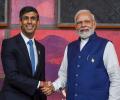
British Prime Minister Rishi Sunak has said that the UK government remains committed to working "as quickly as possible" towards a successful conclusion to the ongoing free trade agreement (FTA) talks with India, as the majority of the substantive negotiation conversations were completed at the end of last month. At a House of Commons session on the G20 Summit in Indonesia on Thursday, the British Indian leader updated Parliament that he reviewed progress on the FTA during his first meeting with Prime Minister Narendra Modi since taking charge at 10 Downing Street. He was questioned by Opposition Labour Party Leader Keir Starmer and his own Conservative Party MPs on the timeline for the completion of the agreement with India.
Talks on an India-European Union Free Trade Agreement started in 2007. Six rounds of negotiations have been held but the two sides have not been able to arrive at a consensus on the level of trade to be covered under the FTA that will eventually eliminate duties on goods traded.

All entities operating in India must fully comply with relevant laws, External Affairs Minister S Jaishankar Wednesday told his British counterpart James Cleverly, who raised the BBC tax surveys issue during a meeting with him.

A day after lambasting e-commerce players for predatory pricing, Union Commerce Minister Piyush Goyal on Thursday said he is not against online platforms but India wants such entities to be "fair and honest" in their conduct. Speaking with reporters in the financial capital, the outspoken Union minister said the rule of the law should be followed in letter and spirit, and made it clear that consumer preferences should not be influenced by algorithms.
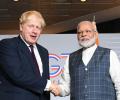
The visit, which is expected around April 22, is long overdue after Johnson was forced to cancel planned visits to India twice last year due to the COVID-19 pandemic.
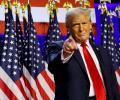
American President Donald Trump has announced imposing reciprocal tariffs on its major trading partners including China that levy higher import duties on goods shipped from the United States. He has already announced a 25 per cent duty on steel and aluminium imports, which will come into effect from March 12.
India and Singapore will hold bilateral talks on a comprehensive economic cooperation agreement after completion of a joint study on free trade, Singapore President S R Nathan indicated on Monday. \n\n

Johnson's first visit to India as United Kingdom prime minister will begin on April 21 with a trip to Ahmedabad in Gujarat, which is Prime Minister Modi's home state.
Industry body Assocham has advised the government to enter into a Preferential Trade Agreement with China instead of a Free Trade Agreement. The chamber has prescribed a minimum period of 5 years before the two countries finalise the FTA. Tariff cuts due to FTA will see the Chinese goods flood Indian markets. While with a PTA, tariffs could be reduced in a phased manner. Indo-China FTA might affect economic efficiency of these countries as they would exclude other countries.
The European Union may back off from its insistence on including non-trade issues like human rights in the proposed free trade pact with India.
